High-precision dyadic number operations. More...
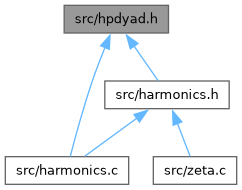
Go to the source code of this file.
Classes | |
| struct | hpdyad_t |
| Fixed-size high-precision dyadic number (hpdyad) with separate sign and binary exponent. More... | |
Macros | |
| #define | HPDYAD_MAX_LIMBS 32 |
| Maximum number of 32-bit limbs in fixed-size representation (1024 bits total). | |
Functions | |
| unsigned | ctz64 (unsigned long long x) |
| Count trailing zero bits in a 64-bit unsigned integer. | |
| int | msb32 (unsigned int x) |
| Find index of most significant bit in a 32-bit unsigned integer. | |
| void | hpdyad_set_ull (hpdyad_t *a, unsigned long long x, signed char sign) |
| Initialize hpdyad from unsigned long long with sign. | |
| void | hpdyad_normalize (hpdyad_t *a) |
| Normalize hpdyad: trim leading zeros and left-shift mantissa so MSB of top limb is 1. | |
| void | hpdyad_mul (hpdyad_t *out, const hpdyad_t *a, const hpdyad_t *b) |
| Multiply two high precision dyadic numbers (hpdyad's): out = a * b. | |
| void | hpdyad_shr_bits_sticky (hpdyad_t *dst, const hpdyad_t *src, unsigned int bits) |
| Right-shift mantissa with sticky bit (value-preserving) | |
| void | hpdyad_shl_bits (hpdyad_t *dst, const hpdyad_t *src, int bits) |
| Left-shift mantissa by specified number of bits (value-preserving) | |
| void | hpdyad_add (hpdyad_t *out, const hpdyad_t *a, const hpdyad_t *b) |
| Add two high precision dyadic numbers (hpdyad's): out = a + b. | |
| double | hpdyad_to_double (const hpdyad_t *a) |
| Convert hpdyad to double with round-to-nearest-even. | |
Detailed Description
High-precision dyadic number operations.
Function Documentation
◆ ctz64()
| unsigned ctz64 | ( | unsigned long long | x | ) |
Count trailing zero bits in a 64-bit unsigned integer.
- Parameters
-
[in] x input value
- Returns
- number of trailing zeros (0..63); returns 64 if x == 0
◆ hpdyad_add()
Add two high precision dyadic numbers (hpdyad's): out = a + b.
- Parameters
-
[out] out result (supports aliasing) [in] a first operand [in] b second operand
◆ hpdyad_mul()
Multiply two high precision dyadic numbers (hpdyad's): out = a * b.
- Parameters
-
[out] out result (may alias a or b) [in] a first operand [in] b second operand
◆ hpdyad_normalize()
| void hpdyad_normalize | ( | hpdyad_t * | a | ) |
Normalize hpdyad: trim leading zeros and left-shift mantissa so MSB of top limb is 1.
- Parameters
-
[in,out] a pointer to hpdyad to normalize
- Returns
- void
◆ hpdyad_set_ull()
| void hpdyad_set_ull | ( | hpdyad_t * | a, |
| unsigned long long | x, | ||
| signed char | sign ) |
Initialize hpdyad from unsigned long long with sign.
- Parameters
-
[out] a destination hpdyad [in] x unsigned integer value [in] sign +1 or -1
◆ hpdyad_shl_bits()
Left-shift mantissa by specified number of bits (value-preserving)
- Parameters
-
[out] dst destination hpdyad [in] src source hpdyad [in] bits number of bits to shift left
- Returns
- void
◆ hpdyad_shr_bits_sticky()
Right-shift mantissa with sticky bit (value-preserving)
Shifts mantissa right by bits, increments exp2 by bits to preserve value. Any 1-bit shifted out ORs into bit 0 (sticky). Does NOT normalize.
- Parameters
-
[out] dst destination hpdyad [in] src source hpdyad [in] bits number of bits to shift right
◆ hpdyad_to_double()
| double hpdyad_to_double | ( | const hpdyad_t * | a | ) |
Convert hpdyad to double with round-to-nearest-even.
- Parameters
-
[in] a pointer to normalized hpdyad
- Returns
- closest double representation; ±DBL_MAX on overflow
◆ msb32()
| int msb32 | ( | unsigned int | x | ) |
Find index of most significant bit in a 32-bit unsigned integer.
- Parameters
-
[in] x input value
- Returns
- bit index 0..31; returns 0 for x == 0 (defensive fallback)